
Where to find currency pairs
How the instrument list is organised and what the markers mean.
Find the instrument you need quickly and understand what is shown beside its name.
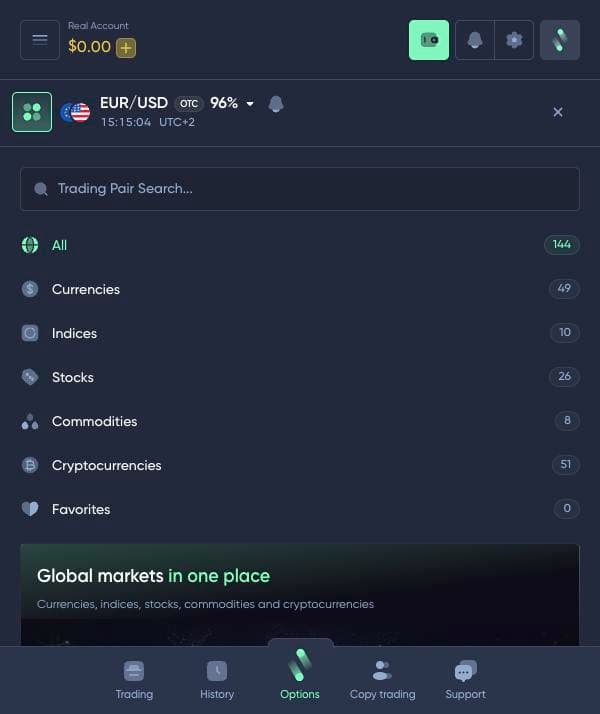
The instrument list opens from the upper part of the screen and is usually grouped by class: Currencies, Crypto, Commodities, Stocks, Indices. Currency pairs are the first group, and almost everyone starts there.
- EUR/USD
- — The most liquid pair, a calmer and more readable move
- GBP/USD
- — More mobile, longer impulses, sharper reactions
- USD/JPY
- — Sensitive to the Asian session
- AUD/USD
- — Reacts to the commodity backdrop
Beside the instrument name there is usually the current payout, and beside some of them an OTC marker. The first number changes through the day; the second means a different way of forming quotes.
The list is long on purpose, and that is its trap. The number of instruments is a reason to pick one and learn it, not a reason to try all of them.
A pair you cannot describe in one sentence is not yet yours. “EUR/USD is calmer than GBP/USD and reacts to European data” is a description. “It is in the list” is not.
The usual mistake
Treating the OTC version of a pair as the same instrument. The name matches, the way the quotes are formed does not.
Key takeaways
- The list is grouped by class; currency pairs are where almost everyone starts.
- Beside the name sit the payout and, for some, an OTC marker.
- The length of the list is a reason to choose one instrument, not to try them all.
A note from Leon Mercer Academy
Write a one-sentence description of your instrument in the journal. If the sentence will not form, you do not know it yet.
A practical example
Open the list and find the same pair in two places: in Currencies and among the OTC instruments. The name matches; the behaviour does not.
Note the payout for both. They often differ by ten percentage points or more, which is the platform pricing the difference in risk.
Lesson 8 of 15 in “BINODEX START”