
The BUY button
What exactly you are claiming when you press it.
State a buy idea as a checkable claim rather than a wish.
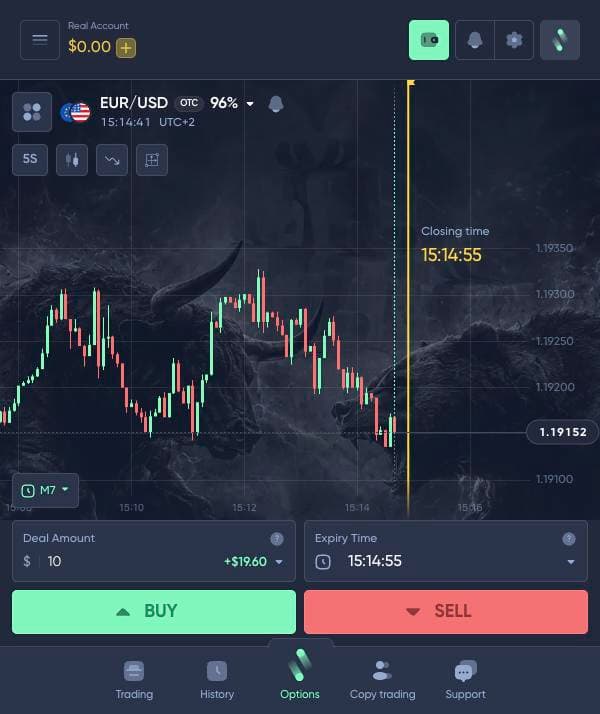
The BUY button means exactly one claim: at expiry the price will be higher than the entry price. Not “much higher”, not “after a rise” — just higher, by at least the minimum step.
So an idea always has two halves: why I expect a rise, and what will prove I was wrong.
- The reason
- — An upward structure, price bounced from a tested support zone
- The invalidation
- — A close below the previous low
- The expiry
- — 5 minutes — about as long as a move to the next level usually takes
If the second half will not form, it is not an idea. Without a boundary for being wrong you can neither assess the risk nor draw a conclusion afterwards.
A psychological trap: beginners press BUY more often, because a rise is subconsciously received as “good”. The market has no favourite direction, and your statistics should not either.
The usual mistake
Buying at the end of a sharp impulse, when the move already looks obvious. That is the worst reference point available.
Key takeaways
- BUY is the claim that price will be above the entry at expiry.
- An idea holds a reason and a boundary of invalidation.
- A lean towards buys is a psychological pattern, not a market one.
A note from Leon Mercer Academy
Write the entry price down yourself before pressing. The platform will show it too, but a written number is harder to move in your memory in your own favour afterwards.
A practical example
A bad idea: “three green candles in a row, I am buying.”
A working idea: “upward structure on M5, the correction ended with a higher low, buy for 5 minutes, invalidated by a close below that low.”
The second forms in one sentence and contains the boundary at which you admit the mistake.
Lesson 14 of 15 in “BINODEX START”